75 Years - Reller History

Toll Free: 1-800-233-4820 • E-mail: Bernard@RellerGold.com
75 Years - Reller History | |
| Phone:
352-372-2337
•
Fax: 352-372-9629 Toll Free: 1-800-233-4820 • E-mail: Bernard@RellerGold.com |
|
 | ||
 |
When
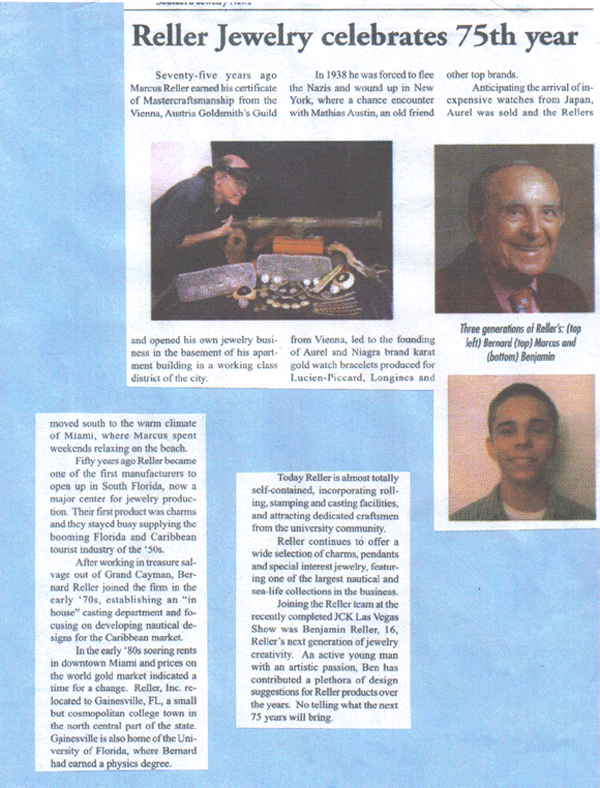
Marcus Reller says he's from the old school, he's not kidding. Reller, the 86-year-old patriarch of Reller Inc., a fine jewelry manufacturer in Gainesville, FL, entered the jewelry trade at age 15 as a apprentice in Vienna, Austria. As a young apprentice, he'd come to the shop early in the morning, before the jewelers arrived, and stoke the wood stove so they'd be warm. "You had a potbelly in the middle of the room, and you had to keep the stove burning," Reller recalls. Under the tutelage of "journeymen" and master craftsmen, Reller learned jewelry-making skills that would shape his long career. "Each apprentice served four journeymen," Reller says. "We made pendants, pillboxes and cigarette cases. "We learned how to roll wire, how to melt, how to solder. Some of these phases of jewelry-making were done in primitive ways. We soldered with a blowpipe, holding the tubing in our mouths to direct the flow of air. "And we were paid a fraction of what the [more experienced] jewelers were paid. If they made $50 a week, an apprentice got $4 to $6 a week." Lehrgeld zahlen. Loosely translated, that's German for dues paying, one of the featured "courses" in "the old school". |
|
|
| ||
|
Reller paid many dues while honing his jewelry skills. But
after four
years as an apprentice, he passed the journeyman's test that is given
by Genossenchaft der Juweliere, the goldsmiths' guild in Vienna. At age 25, he became a master craftsman, a lofty status that entitled him to open his own shop and employ journeymen and apprentices. Within five years, Reller built a business manufacturing "high-fashion cigarette cases, lockets, powder compacts - anything with hinges." His customers included "the bests houses in Europe." In the 1930s, he became "politically aware", and with the occupation of Austria by Hitler, Reller, who is of Jewish descent, fled to Italy with just a small briefcase and $5 in tow. "They were arresting Jewish-looking people in the streets," Reller says. "Within an hour I decided to escape, and took a propeller-driven plane to Italy." While awaiting his U.S. visa, he worked as a jeweler in Naples. And on March 2, 1939, he arrived by boat in New York with 50 cents in his pocket. Reller would go on to prove that back then, a little bit of change went a long way. Making a Case for Success Later that year, Reller unexpectedly ran into Mathia Austin, an old friend from Vienna. They were eager to work together. But as Reller says, "It was the war years. You couldn't make plans. I was subject to the draft. I wasn't sure what was going to happen to me." During the war, Reller worked at various jewelry industry jobs in New York and New Jersey, eventually making cases as a subcontractor for Cartier. |
In 1945, he and Austin finally
became a team, forming Aurel Jewelry, a New York City-based operation
that produced 14k watch bracelets for high-quality companies such as
Omega, Hamilton, Longines and Benrus. By 1955, the watch market was "being hurt by low-cost imports," Reller says, and in 1956 Aurel was dissolved. Reller had fallen in love with the climate and lifestyle of Miami, where he maintained a winter home. So he decided to make it a permanent residence and open Reller Inc. in the Professional Building in Miami in 1956. (A few years later he became one of the first manufacturers to move into the famous Seybold Building in downtown Miami). The palm tree became the registered trademark of the company, which established itself as one of the major charm houses of the '50s and '60s. "The charm business flourished for two decades, starting in the late '50s. Anyone who didn't have a charm wasn't a human being," Reller says tongue in cheek. In the '60s, Reller built an extensive line of regional souvenir jewelry with motifs such as gold palm trees, orange crates and alligators. In addition, Reller drew on his tool and die experience and started producing coin mountings, which remain a mainstay of the company. In the '70s, Reller's only son, Bernard, joined the business. He quickly became active in designing jewelry under the name "Collections by Bernard" for affluent nautical aficionados. By the early 1980s, the company had left the "cramped quarters" of the Seybold Building, and moved to Gainesville. Ownership of the business was transferred to Bernard, and after a year in Gainesville, Marcus returned to the bustle of downtown Miami and opened a branch office in the Seybold Building. Still In Touch |
These
days, Marcus jogs every morning and enjoys afternoons
lounging in the rejuvenating Florida sun. He passionately follows world
political and economic developments by listening to shortwave radio and
reading foreign periodicals. But as an official director of Reller Inc., he works a few hours each day, using the Seybold office as a convenient place for functions such as meeting with buyers from South Florida, the Caribbean and Latin America. In addition, he attends major trade shows to keep his finger on the pulse of the modern jewelry industry. As in the days when Reller began making charms and souvenir jewelry, the company still favors thematic jewelry - collections based on endangered wildlife, aviation, sports and nautical motifs, as well as pieces made with replicas of Spanish artifacts produced from metal actually found on the 17th century shipwreck of the Atocha. Unlike the Atocha, Marcus Reller has survived some rough sailing. And now, in the twilight of his career, he is able to look at the broader picture of the industry in which he grew up. It is an industry that has hit its share of jolting waves in recent times. "The future of the jewelry business will be survival of the fittest", Reller says. "You have to know how to satisfy old customers. It's easier to make an old customer happy than it is to find a new customer. "And I believe in quality control from the first step to the last. The first step has to be perfect, as does the last. If the boss is a perfectionist, the people who work for him will strive for perfection. "But the jewelry manufacturing industry in the United States has made great advances. In fact, in my opinion, it is the best jewelry in the world". |
Return to Top | ||
 Return to Top |
 | |||||
|
Reller's
Love of the By
David JonesSea Is Authentic The storm struck on the 5th of September in 1622, one day out of Havana. The winds increased steadily to hurricane force, the 14 ships of Spain's Tierra Firme Fleet were among the reefs and keys of Southern Florida. When the seas subsided, the flagship of the Fleet, the Galleon "Nuestra Senora de Atocha" and her sister ship, the "Santa Margarita" lay in shallow water within a few miles of each other. Thus begins the story of a salvage operation that has spanned four centuries culminating in Mel Fisher's successful location of the Mother Lode - the main body of the Atocha Treasure - in 1985. Undoubtedly, the Atocha Treasure is one of the riches finds in the history of Treasure Salvage. But Atocha represents only one of many such treasure wrecks in the Caribbean and the coast of Florida. In the summer of 1973, Bernard Reller left the graduate physics program at the University of Florida to join the search for the sunken treasure in the Western Caribbean. With his electronic and mechanical back-ground, Reller managed to sign on with Capt. John Leeper of the Research Vessel |
"Beta"
as his magnetometer operator and diesel engineer. The "Beta" is
a forty foot twin diesel catamaran custom built in Leeper's San Pedro
Boat Works, specifically for treasure salvage. Leeper had teamed up
earlier with Fisher to explore the Silver Shoals off the Dominican
Republic. RV "Beta" was the product of his marine engineering
expertise. Reller's working relationship with the "Beta" spanned three
years during which he gained an abundance of maritime and scuba
experience. Upon his return to Miami, Bernard turned his technical abilities to lost wax casting and founded Casting PBS, a company geared to service one and only one account. That account was Marcus Reller, an Austrian Master craftsman who had "retired" from New York (Aurel - Niagara Bracelets) only to become a leading Florida manufacturer. Bernard soon saw a niche in the marketplace for jewelry that celebrated his love for the sea. "Certainly, the marketplace had anchors, boats and dolphins, but they were often inaccurate and out of proportion. No designer offered a complete collection that could appeal to people whose life was the sea", he said. | Thus
Bernard set about creating a comprehensive Nautical Collection. Adopting the trade name Collections by Bernard, he displayed his work alongside that of his well-known father, Marcus, at the major trade shows. Over the years, Bernard has maintained his friendships with well known members of the Treasure Salvage community. "Shipwreck coins, artifacts and replicas are a natural companion to the Nautical Collection and access to interesting pieces is of prime importance to my customers", comments Reller. "Mel Fisher's well publicized success with the ATOCHA treasure has been a boon to treasure jewelry sales but it is important to remember that other treasure finds also have interesting stories and yield similarly interesting artifacts." Bernard's Treasure Collection represents coins and artifacts from many prominent treasure salvors from around the world. "Every expedition represents dreams and toils, successes and tragedies of dedicated adventurers. The treasure business is never dull." |
Most
recently, Reller spent time diving undisclosed locations in the Red Sea
and
exploring ancient sites in the Jordanian desert in search of coins and
artifacts from early inhabitants of the region. In addition to his Nautical and Treasure Collections, Reller's activities as fixed wing and hot air balloon pilot have given rise to the Tailwinds Collection of gold aviation jewelry, marketed primarily through aviation gift catalogs. "Private label" manufacturing for major retailers fills out production activities at Reller's workshops, activities which include hand construction, blanking and die forming, sheet & wire production as well as investment casting. Reller, who worked at the University of Florida Physics department constructing experimental apparatus, has designed and built much of his own production equipment and tooling.  | ||
| Return to | ||||
75 Years - Reller History |
|  |
The information
contained in this site is copyright protected. It may not be used
without prior written consent from Reller, Inc., or its partner
companies. The designs in this site are also trademark protected.
Under trademark law designs that come close to, or are deliberate
imitations of or bear similarity of the use infringes on trademark law
and may be prosecuted in court.
|
